I have been building Lucid Hire, a Next.js recruiter dashboard with Clerk auth, Neon Postgres, and Polar for subscriptions. The billing page lets recruiters click Upgrade to Pro and navigate to Polar-hosted checkout. In manual testing I had tunneling and env quirks, so I leaned on TestSprite—an MCP-connected E2E runner—to exercise the full app through a real browser session.
One case kept failing: TC013, “Billing page remains usable after returning from external checkout.” The report was blunt: hitting /api/billing/checkout?plan=pro returned HTTP 500 with a generic browser error page—no JSON, no stack trace in the UI.
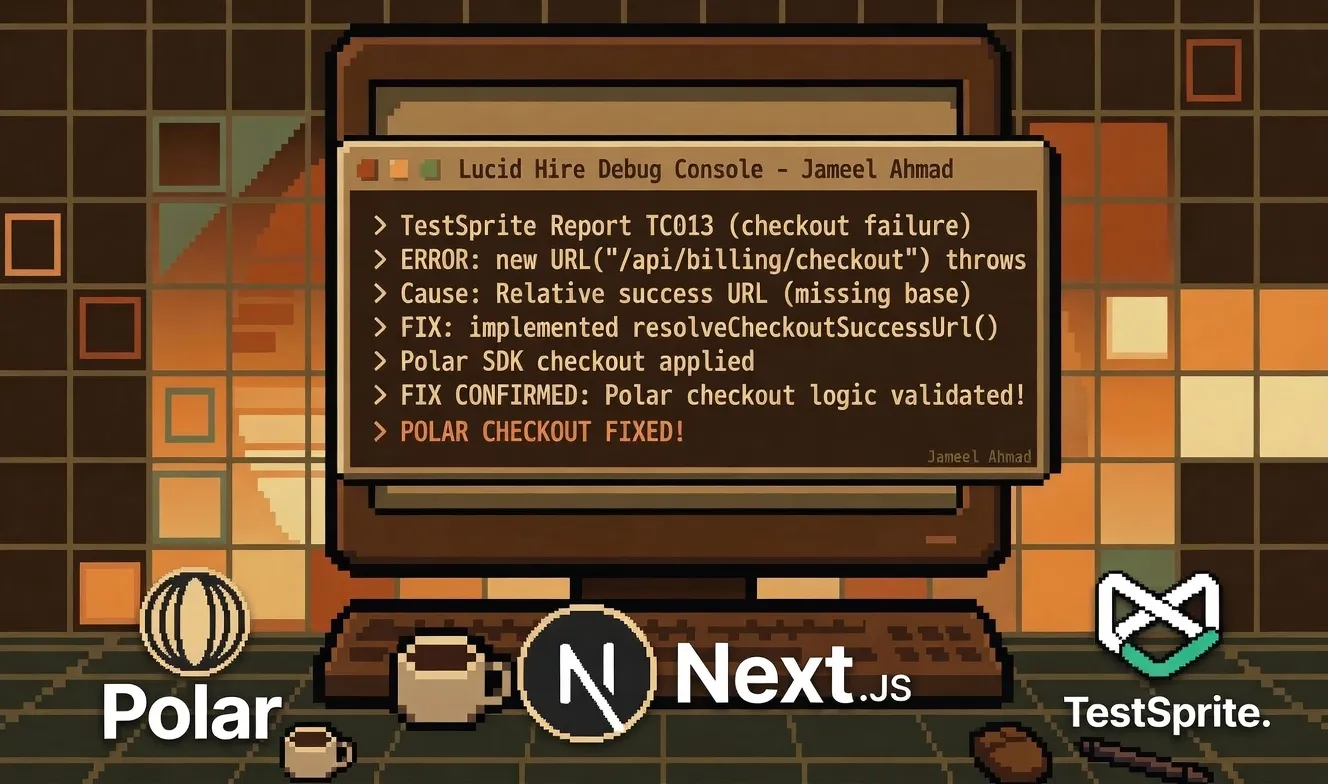
This post is about how that failure was actually a gift: TestSprite reproduced a path I had not fully validated, and chasing it led to a concrete bug in how we integrated Polar—not “Polar is down,” but our route crashing before the SDK could even run.
Table of contents
Open Table of contents
What TestSprite reported
TestSprite generates a frontend test plan, runs Playwright-style flows against my local app (via a tunnel), and writes a report under testsprite_tests/tmp/raw_report.md. For TC013, the relevant excerpt looked like this in spirit:
- The automation navigated to
/api/billing/checkout?plan=pro(same as our real Upgrade button). - The browser showed “This page isn’t working” / HTTP ERROR 500.
- No redirect to Polar, so the test correctly marked a failure.
That told me the bug was server-side in our checkout API route, not a flaky click in the billing UI.
Following the trail to src/app/api/billing/checkout/route.ts
Our billing client triggers checkout with a full-page navigation—simple and intentional:
const startUpgrade = (plan: "pro" | "max") => {
  setLoadingPlan(plan);
  window.location.href = `/api/billing/checkout?plan=${plan}`;
};
So every upgrade goes through GET /api/billing/checkout. I opened the route handler next.
Originally, the route used Checkout from @polar-sh/nextjs, which wraps @polar-sh/sdk and builds a checkout session from query parameters. On the surface that is the “official” integration. The problem was what happened before Polar’s API was called.
The mystery of the blank 500
Inside @polar-sh/nextjs, the checkout handler does something like this (simplified from the published package):
const success = successUrl ? new URL(successUrl) : void 0;
if (success && includeCheckoutId) {
  success.searchParams.set("checkoutId", "{CHECKOUT_ID}");
}
try {
  const result = await polar.checkouts.create({ /* ... */ });
  return NextResponse.redirect(redirectUrl.toString());
} catch (error) {
  console.error(error);
  return NextResponse.error();
}
Two important details:
-
new URL(successUrl)runs outside thetryblock.
In JavaScript,new URL("/dashboard/settings/billing")throws—relative URLs are invalid without a base. So ifPOLAR_SUCCESS_URLwas unset in a way that still led to bad input, or was documented as a “path only” value, the handler could throw beforetry→ Next.js responds with an unhelpful 500 and no JSON body. -
When the Polar API failed, the helper returned
NextResponse.error().
That is also an opaque 500 from the browser’s point of view. TestSprite (and users) only see “something broke.”
Separately, our README listed POLAR_ACCESS_TOKEN and product IDs but never POLAR_SUCCESS_URL. Locally I had been “fine” until the exact combination of tunnel + env + navigation reproduced the crash in CI-style E2E.
How TestSprite helped beyond “checkout is broken”
Without TestSprite, I might have assumed:
- “Polar credentials are wrong,” or
- “Test user is not allowed to checkout,” or
- “Clerk session is missing.”
The report narrowed it: authenticated flows passed (billing page, plan copy, other cases), but the API route itself returned 500 when used like a real user (full navigation to the API URL). That pushed me to read the route + Polar adapter, not redo Clerk for the tenth time.
So the value was not only automation—it was a reproducible, user-shaped repro attached to logs and video links in the TestSprite dashboard.
The fix: own the checkout flow and make URLs safe
I stopped delegating to @polar-sh/nextjs’s Checkout() for this route and called polar.checkouts.create() from @polar-sh/sdk directly, with:
- A resolver that always produces a valid absolute success URL
- A
try/catchthat returns JSON with a real error message (HTTP 502) when Polar rejects the request
1. Resolve POLAR_SUCCESS_URL safely
Polar needs an absolute success URL. If the env var is missing, we default to returning the user to billing. If it is a relative path, we resolve it against NEXT_PUBLIC_APP_URL, VERCEL_URL, or the incoming request origin:
function resolveCheckoutSuccessUrl(request: NextRequest): URL {
  const raw = process.env.POLAR_SUCCESS_URL?.trim();
  const origin =
    process.env.NEXT_PUBLIC_APP_URL?.replace(/\/$/, "") ||
    (process.env.VERCEL_URL ? `https://${process.env.VERCEL_URL}` : null) ||
    request.nextUrl.origin;

  if (!raw) {
    return new URL("/dashboard/settings/billing", origin);
  }

  try {
    return new URL(raw);
  } catch {
    const path = raw.startsWith("/") ? raw : `/${raw}`;
    return new URL(path, origin);
  }
}
Then we append Polar’s checkoutId={CHECKOUT_ID} placeholder the same way the official helper does:
const successUrl = resolveCheckoutSuccessUrl(request);
successUrl.searchParams.set("checkoutId", "{CHECKOUT_ID}");
2. Create the session and redirect—or return a clear error
const polar = new Polar({
  accessToken,
  server: polarServerFromEnv(),
});

try {
  const result = await polar.checkouts.create({
    products: [productId],
    successUrl: decodeURI(successUrl.toString()),
    externalCustomerId: organization.id,
    customerEmail: appUser.email,
    customerName: appUser.name ?? undefined,
    metadata: { orgId: organization.id },
  });

  return NextResponse.redirect(result.url);
} catch (error) {
  console.error("[billing/checkout] Polar API error:", error);
  return NextResponse.json(
    { error: checkoutErrorMessage(error) },
    { status: 502 },
  );
}
After this change:
- Misconfiguration (wrong token, wrong sandbox vs production product id) still fails—but the response is JSON with a message, and the server log has the Polar error. TestSprite (or curl) can surface that instead of a blank chrome error page.
- Missing or relative
POLAR_SUCCESS_URLno longer crashes the process onnew URL().
What I learned
- E2E tools like TestSprite are not only for “click happy paths.” They excel at boring but exact repros: same URL, same query string, same navigation semantics as production.
- Third-party adapters (
@polar-sh/nextjs) save time until they hide thrown errors or parse env in ways that assume perfect configuration. Sometimes owning the ten lines of SDK calls buys you observability and control. POLAR_SUCCESS_URLshould be documented next to tokens and product IDs: absolute URL preferred; if you use a path, we now resolve it—but you should still setNEXT_PUBLIC_APP_URL(or rely onrequest.nextUrl.originin dev) so the base is correct behind proxies and tunnels.